
Microchip PIC18LF4620T-I/PT 8-Bit Microcontroller: Architecture, Features, and Application Design Considerations
The Microchip PIC18LF4620T-I/PT stands as a robust and versatile member of the renowned PIC18 family of 8-bit microcontrollers. Engineered for complex embedded applications requiring a balance of processing power, peripheral integration, and power efficiency, this MCU is a popular choice across industrial, automotive, and consumer electronics sectors. Its architecture is built around an enhanced Harvard design with a 16-bit wide instruction set, enabling most instructions to execute in a single cycle, thereby boosting throughput despite its 8-bit data bus.
A core architectural highlight is its nanowatt technology, which is pivotal for low-power applications. The "LF" designation signifies its operation over an extended low-voltage range (2.0V to 5.5V), allowing it to run efficiently from regulated power supplies or even directly from batteries. The MCU features 64 KB of flash program memory and 1024 bytes of data EEPROM, providing ample space for sophisticated firmware and non-volatile data storage. With 3936 bytes of RAM, it can comfortably handle complex data structures and real-time operating systems.
The peripheral set is exceptionally rich, making it a true system-on-chip solution. It includes multiple communication interfaces: two Enhanced Universal Synchronous Asynchronous Receiver Transmitters (EUSART), a Master Synchronous Serial Port (MSSP) module that can be configured as either SPI or I²C, and an Addressable Universal Synchronous Asynchronous Receiver Transmitter (AUSART). For analog needs, it integrates a 10-bit Analog-to-Digital Converter (ADC) with up to 13 channels, enabling precise sensor data acquisition. Control-oriented applications are served by two CCP (Capture/Compare/PWM) modules and an Enhanced CCP (ECCP) module, which offers advanced PWM features for motor control.
Application design considerations are critical for leveraging this MCU's full potential. First, power management must be carefully planned. Utilizing the built-in programmable brown-out reset (BOR) and multiple software-selectable sleep modes (IDLE, POWER-DOWN) is essential for maximizing battery life. Designers should strategically place `SLEEP` instructions and manage peripheral clock gating to minimize current consumption.
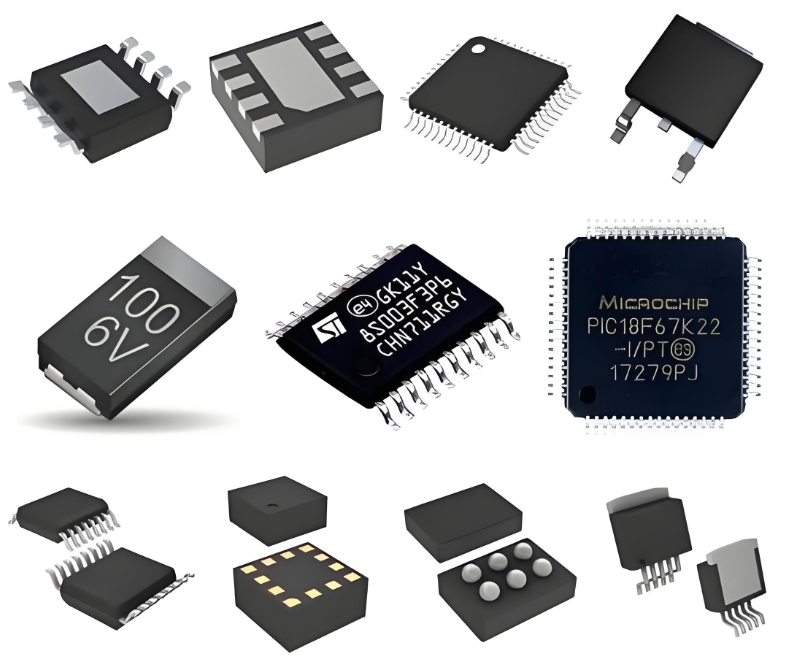
Second, managing the extensive I/O portfolio (44 pins on its TQFP package) requires careful PCB layout to avoid noise, especially on analog and high-speed digital lines. Proper decoupling capacitors near the VDD/VSS pins are mandatory for stable operation.
Third, the 10-bit ADC performance can be susceptible to power supply noise and digital switching noise. Employing a separate, clean analog ground plane and using the internal ADC voltage reference (`VREF+`/`VREF-`) instead of the supply rail can significantly improve conversion accuracy.
Finally, for timing-critical control loops, the hardware PWM and CCP modules should be prioritized over software-generated signals to ensure precision and free up CPU cycles for other tasks. The ECCP module's half-bridge and full-bridge output modes are particularly valuable for driving DC and brushless DC motors efficiently.
In summary, the PIC18LF4620T-I/PT is a highly capable microcontroller whose effectiveness hinges on a deep understanding of its low-power architecture and rich peripheral set.
ICGOODFIND: The PIC18LF4620T-I/PT is a powerhouse for 8-bit control, offering an optimal blend of processing capability, extensive peripherals, and industry-leading low-power operation, making it an excellent choice for a vast array of embedded designs.
Keywords: Low-Power Management, Enhanced Peripherals, 10-Bit ADC, PWM Motor Control, Nanowatt Technology

